

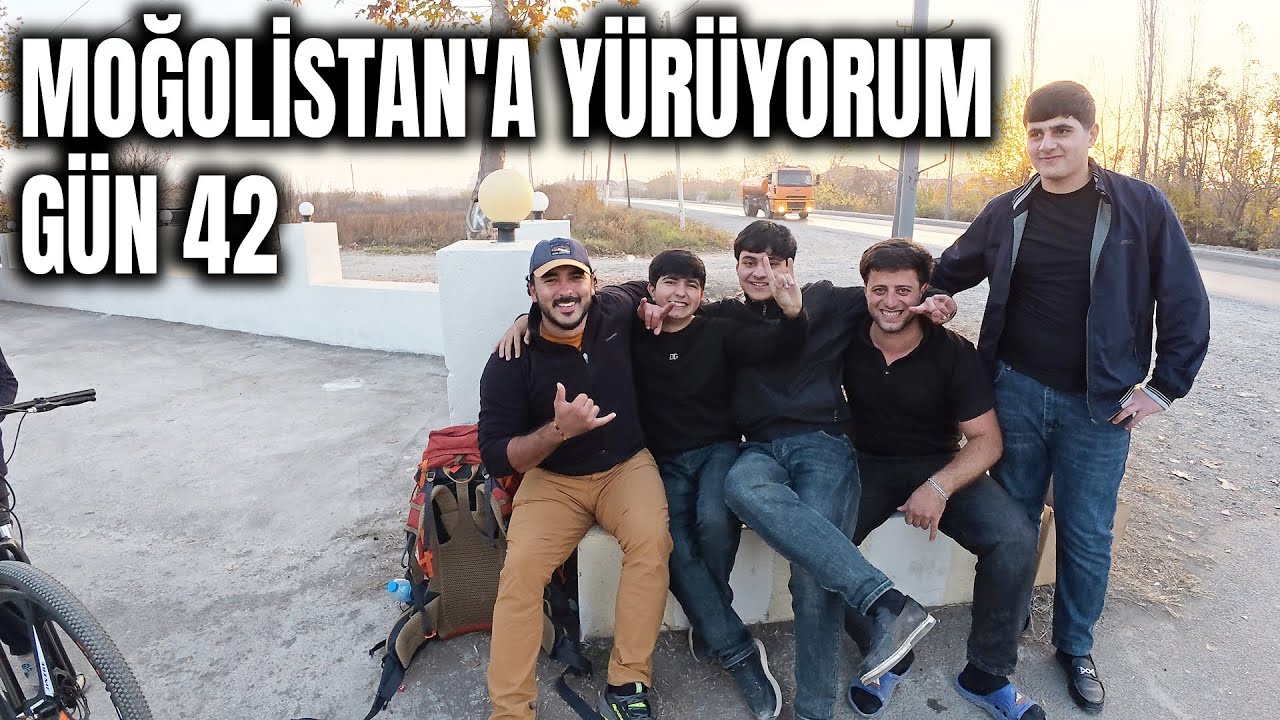
On days 42, 43, and 44 of my walk from Turkey to Mongolia, I left Azerbaijan's main highway and entered the village roads near Karabakh: 39 kilometers from Goranboy to Terter, 29 from Berde to Kuzanlı, and 31 from Kuzanlı to Ağcabedi. I passed through cotton and carrot fields, saw memorials to fallen soldiers in every village, walked past mine warning signs, got shocked by an electric fence, and had to pass through a flock of sheepdogs. In this post, while describing those three days, I also share information that will be useful if you plan to walk or travel with a backpack in this region: route, hotel prices, daily budget, dogs, mined areas, and nutrition on long walks.
Watch the Video: Day 42, From Goranboy to Terter
Day 42: 39 Kilometers from Goranboy to Terter
I spent the night at the Olympia complex in Goranboy. Most of Azerbaijan's small towns and districts have these facilities: large buildings with a gym, swimming pool, and hotel rooms. They are very useful for walkers because there are often few other accommodation options in small places. Goranboy is a small place; I estimate its center has around 30,000 people.
Elnur and his friends hosted me here. Elnur had written to me weeks ago saying, "Stop by if you pass through here," but I had forgotten; I remembered his message while sitting at a gas station. About 10-15 of us gathered, and they took me to the Buzluk plateau at an altitude of 2,000 meters. As we set out in the morning, I happened to run into Elnur's father as well.
Traces of War: Memorials and Mine Warnings
This region is very close to the Armenian border and has experienced two major wars since the 1990s. Almost everyone I met had someone from their family who had gone to war. I saw a memorial or monument in every village I passed. Looking at the dates on the tombstones, one generation died in the 1990s, and the next in 2020. Passing by those stones really makes you sad.
Some signs along the road had pictures of hand grenades and mines: "If you see something like this, do not approach; call us." Today the region is peaceful, but the remnants of war are still in the soil. People told me that the forested and wooded areas had been mined for years, and that sheep and people who lost their way were injured because of this. I always stayed on the asphalt or the clearly marked village road.
Kızılhacılı, Domino, and Naftalan's Oil Bath
At the exit of Goranboy, there is a sculpture of a globe in the middle of the road with the words "Yahşi yol" (Good road); a nice send-off for someone like me heading out on the road. In the village of Kızılhacılı, some older men playing dominoes invited me for tea, and I had two teas and some halva. In these villages, the elderly play dominoes and backgammon during the day, the young people work, and the children are at school.
I saw Naftalan signs on the road. Naftalan is a town known for its bath treatment made with its unique oil; it apparently gets many visitors, especially from Russia, and has luxury hotels. When I asked about the price, they said 40-50 manats, but they also added, "It won't be good for you; it tightens your skin, and then you'll catch a cold." I didn't go in. If you're curious, I recommend consulting a doctor before starting these kinds of treatments.
Han Kervend, a 24-Manat Lunch, and a Police Check
In the village of Han Kervend, children recognized me from TikTok and waved. There were many people who stopped on the road to greet me, ask, "Do you need anything?" and invite me to their homes. I thank them and choose to stay at the hotel every time; after walking 30-40 kilometers a day, I need to shower and rest, and check my video work in the evening.
I had lunch at a family restaurant at the exit of Goranboy: soup, turkey, shepherd's salad, a liter of fruit juice, and water. The bill came to 24 manats. The older men I met inside wanted to pay the bill, but I didn't let them; we almost had an argument.
In the afternoon, for the first time, a policeman stopped me and asked for my ID. When he saw I was Turkish, he asked, "Do you need anything?" and left. Frankly, it's normal for someone to ask for ID since Georgia, as this place is close to the border and military vehicles are constantly passing on the road. Always carry your passport with you in this region.
Wolf, Smoke, and Terter in the Dark
Near Taze Kent, I saw a wolf tearing apart and eating a sheep in a field. When I asked a boy on a bicycle, he said that wolves sometimes come down to the village. Towards evening, because straw was being burned in the fields, the road remained in thick smoke for hours, and my eyes watered. It started getting dark at 17:30, and I walked the last hour in the dark.
A night at the Olympia hotel in Terter was 60 manats, which was twice the price of where I stayed the previous night. They gave me a room for three. My watch showed 39.04 kilometers that day. I was so tired that I didn't even go out for dinner, though I realized the next morning that this was a mistake.
Watch the Video: Day 43, From Berde to Kuzanlı
Day 43: From Berde to Kuzanlı, Through Carrot Fields
I wanted to rest in Terter for another night, but the hotel was full; another hotel could only offer a shared room for four. Terter is a small place with 20,000 people, and accommodation options are very limited. A banker I met on the road took me to Berde, 20 minutes away by car. In the morning, he offered to drop me back in Terter, but the distance from Berde to Kuzanlı was the same as the route I would take from Terter. So I continued my walk from Berde.
Berde is one of the largest centers in the region: its center has about 100,000 people, and with the affiliated villages, 200,000. There are 5-10 hotels, and the prices are the same as in Terter. I learned that the only clinic in the region that can take X-rays is here. My banker friend told me that at the end of the 2020 war, a missile hit the city, and civilians sitting in a park lost their lives. Today the buildings look new, but the city was heavily damaged at that time.
The Letter "Ə" in the Azerbaijani Alphabet
Because I saw Bərdə and Tərtər written on signs, I was reading them as "Barda" and "Tartar" in the first few days. I couldn't figure out this letter in the video, so I'll clarify it here: in Azerbaijani Turkish, "e" and "ə" are two separate letters. "Ə" is a more open "e" sound, like in the Turkish words "el" and "sen". So Bərdə is read as "Berde", Tərtər as "Terter", and Ağcabədi as "Ağcabedi".
Şirvanlı Village, Electric Fence, and Bamboo
The weather was 8 degrees and cloudy; much better for walking than the sun. In the village of Şirvanlı, the walls of all the houses were the same height and color. When an older man at the coffeehouse asked me where I was going, I said "Mongolia"; he called me "brave" and invited me to eat. I don't use the camera much so as not to disturb the elderly in the villages, so most of the best moments are not in the video.
The thing that surprised me most on the road was bamboo; I thought bamboo only grew in wet areas, but it was everywhere here. Then, to take a break, I climbed over a wire at the edge of a field and got shocked in my leg. It was an electric fence set up to keep cows off the road, and there was no warning. It's not lethal, but it gives you a serious shock. Think twice before touching the wires at the edge of fields in this region.
Entering Ağdam and the "Karabakh is Azerbaijan" Monument
As I approached Kuzanlı, the villages were surrounded by carrot fields; black and orange carrots were being loaded onto trucks. A family gave me carrots from the field; they were the freshest carrots I had ever eaten. Along the road, I saw farmers selling their produce by the crate. A butcher told me that during the time we filmed the video, the price of meat per kilogram had risen from 12 to 21 manats in two to three years.
Then I arrived at the entrance of the Ağdam region. There is a huge Azerbaijani flag, a map of the country, and the words "Karabakh is Azerbaijan". According to what I was told, Ağdam has suffered the most losses since 1990. Everything has been rebuilt after the war: new sidewalks, planted roads, and orderly villages. In the last few kilometers, a high school student accompanied me; he also told me that Kuzanlı had been rebuilt after the war.
The only place I could stay in Kuzanlı was again the Olympia hotel, and it was the worst room I had stayed in to date: damp walls and a worn-out building twenty years old. To avoid touching the bed, I opened my sleeping bag and slept inside it. My watch showed 28.89 kilometers.
Watch the Video: Day 44, From Kuzanlı to Ağcabedi
Day 44: From Village Roads to Ağcabedi
In the morning, the weather was 5-7 degrees; winter had arrived. Instead of the main road, I entered a village road that doesn't even appear on Google Maps. The name of the first village I passed was Oğuzanlı; it's missing an "h" from my name. I had an incredible coincidence here: a woman stopping beside me in her car asked, "Are you going to Ateş?" Ateş was a friend from Maraş I had met on the road a day before, who had married and settled here, and this woman was his mother-in-law. Without knowing it, I was passing through their village.
According to what Ateş told me, most of the people living in these villages are families who came from Karabakh during the war in the 1990s. The state built houses for them in series and settled them here.
Shepherd Dogs and the Pipe Bridge
The price of the village road was the dogs. First, I passed through 15-20 dogs; most just barked. Then large shepherd dogs protecting a flock surrounded me and didn't want to let me pass. The owner of the flock, a woman, chased the dogs away with a stick in her hand and let me pass. These dogs are not street dogs; their job is to protect the flock from wolves, and I was passing through their territory. I learned my lesson: in the countryside, it's smarter to take a longer route than to pass through where you see a flock and a pen.
To get onto the main road, I crossed a bridge made of two large iron pipes over the canal. At the 13th kilometer, I stopped by the canal and ate a banana, an orange, and chocolate.
Horse Farmer, Cotton, and Maraş Seeds
During a break, I chatted with a farmer who came to me with his horses. He said that in this region, a 4-year-old horse costs 800-1,000 manats, which is about 600 dollars. And to buy a horse, you need to get a document from the notary. He also gave me some good information: the cotton planted in the villages comes from Kahramanmaraş, most of the experts are Turkish, and a large part of the product is sold to Turkey. Along with cotton, carrots, wheat, barley, corn, and watermelon are also grown.
Among those who stopped their cars on the road were friends I had met in Gence, a military doctor, and Azerbaijanis living in Germany. Most ask, "Did the state send you, and are they paying you?" Since it's hard to explain being a YouTuber, I usually say I'm a computer engineer, that I walk during the day and work in the hotel in the evening.
Arrival in Ağcabedi
At the entrance of Ağcabedi, there is an unopened shopping mall, a flag museum, and the words "I love Ağcabedi". As it got dark, I arrived at the Royal Palace hotel. Two nights for 110 manats, a clean and single room; after three nights in bad hotels, it was like a reward. My watch showed 30.59 kilometers. The door rang before I could get into the shower: a man I had met on the road had sent hot bread.
Walking on the Karabakh Road: Practical Information
1. Route and Distances
| Day | Stage | Distance | Accommodation |
|---|---|---|---|
| 42 | Goranboy - Terter | 39.04 km | Terter Olympia, 60 manats |
| 43 | Berde - Kuzanlı | 28.89 km | Kuzanlı Olympia, damp |
| 44 | Kuzanlı - Ağcabedi | 30.59 km | Royal Palace, 2 nights 110 manats |
I chose this route to reach Astara on the Iranian border by the shortest way instead of going down to Baku. My normal route did not pass through Kuzanlı; I walked an extra 10 kilometers to break up a 50-kilometer gap without accommodation.
2. Accommodation: Olympia Complexes
In small districts, the only option is often the hotels of the Olympia sports complexes. The prices were between 30-60 manats at the time we filmed the video, and the quality varies greatly. In small places like Terter, you may not find a room; in larger centers like Berde and Ağcabedi, there are more options. You may want to see the room before booking it; I discovered at one hotel that they had given me a damp room and the next room was clean when I was leaving. I explained ways to stay cheaper in my cheap accommodation guide.
3. Daily Budget
- Accommodation: approximately 18-40 dollars per night (30-60 manats)
- Food: a filling meal at a restaurant is about 24 manats, which is 14 dollars
- Total: at least 50, at most 100 dollars a day for me
- Shoes: every 1,000 kilometers, about 150-200 dollars
Walking is not as cheap as people think: because you cover little distance, you pay for accommodation every night and need to eat well. 1 dollar is about 1.7 manats; prices may change, check the current situation.
4. Mine, Dog, and Wolf
In areas close to Karabakh, do not leave the marked road, and do not take shortcuts through forested and uncultivated areas. When you see a mine warning sign, do not touch anything. Shepherd dogs protecting flocks are a serious danger; stay away from places with pens and flocks. Wolves sometimes come down to the villages, so plan to arrive at your accommodation before it gets dark.
5. How Many Kilometers Should You Walk a Day?
After walking 40 kilometers two days in a row, I realized that was too much for me. I walk about 5 kilometers an hour and take a half-hour break every 10 kilometers. In November-December, the sun rises at 7 and sets at 18, so you have 11 hours in hand. Therefore, with a 15-kilogram backpack, the ideal distance for me is 30 kilometers a day. When you push yourself to 40, the risk of injury, walking at night, and losing the next day increases.
6. Nutrition and Equipment
To avoid losing muscle on long walks, I eat a protein-heavy diet: meat, eggs, milk. I try to get magnesium from almonds, walnuts, and hazelnuts instead of pills, and potassium from bananas. On days when I sweat a lot, my need for salt and pickles increases. A little dark chocolate and coffee in the afternoon gives me energy. The day I skipped dinner, I had trouble getting out of bed the next morning. I learned my lesson about shoes: the life of walking shoes is about 1,000 kilometers, and mine burst at the sides at 1,100 kilometers. Waterproof shoes worked in rainy Georgia, and I will switch to lighter shoes in the dry region. I explained what I carried in my travel equipment guide.
7. Internet
Mobile internet is essential for location, messaging with local friends, and researching hotels on village roads that do not appear on Google Maps. You can check Azerbaijan eSIM packages from Yırtık eSIM.
Frequently Asked Questions
Where to stay in Berde?
Berde is one of the largest centers in the region and there are 5-10 hotels; the prices were at the same level as the Olympia hotels in the surrounding area when we filmed the video. If you cannot find a place in Terter, Berde is 20 minutes away.
Is it safe to walk in areas close to Karabakh?
People are very helpful and police and soldiers are everywhere. The real risks are mined areas, shepherd dogs, and wolves. If you do not leave the marked road and walk during the day, you will not have problems.
How much is the oil bath in Naftalan?
I was told it was around 40-50 manats at the time we filmed the video. The local people say it may not be good for everyone; consult a doctor before trying.
How is the letter "ə" pronounced in Azerbaijan?
Like the open "e" sound in Turkish. Bərdə is read as "Berde", Tərtər as "Terter", Ağcabədi as "Ağcabedi".
Where to stay in Ağcabedi?
I stayed at the Royal Palace hotel at the entrance of the city: two nights for 110 manats, a clean and single room. There are other hotels in the city.
In my previous Azerbaijan post, I told the days I walked from Tovuz to Şemkir, Gence, and Goranboy: Walking in Azerbaijan: From Tovuz to Gence. After resting for two days in Ağcabedi, I will tell the route I took towards Astara on the Iranian border in my next post.


0 comments