

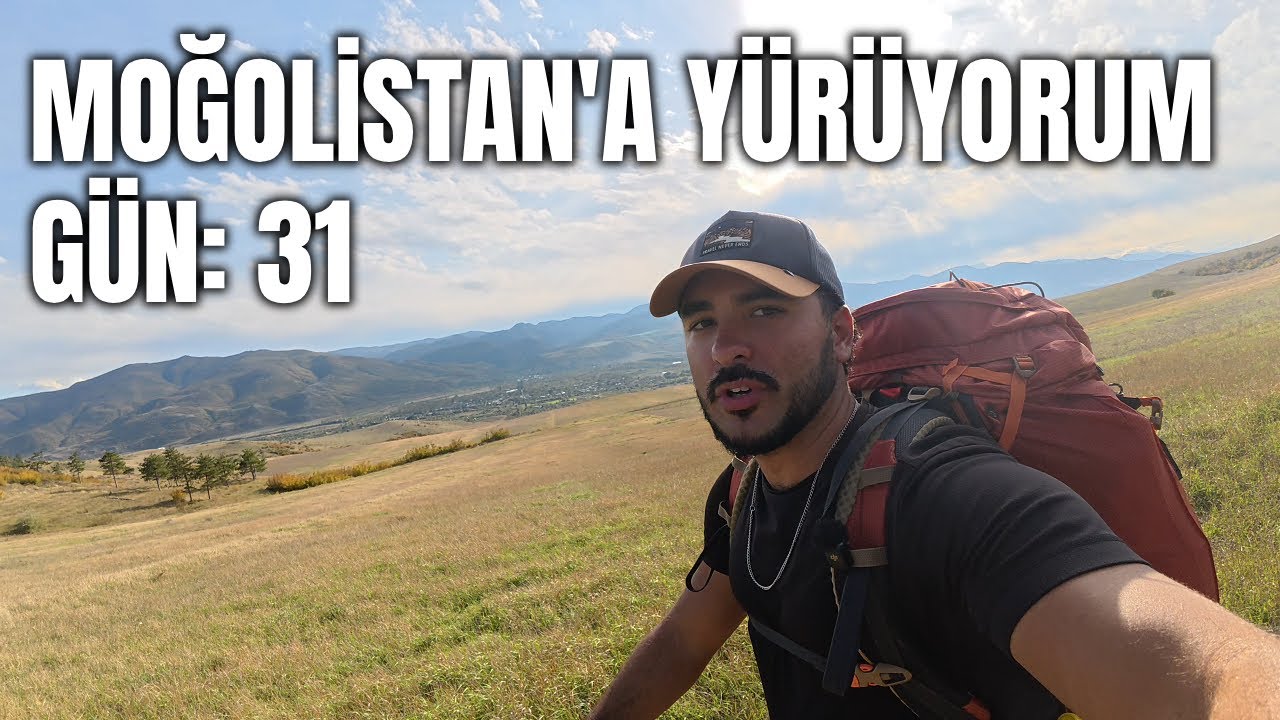
On days 31, 32, and 33 of my walk from Turkey to Mongolia, I completed the last major leg in central Georgia: from Agara to Gori, from Gori toward the road to Tbilisi, and then to the gates of the capital. I walked approximately 89 kilometers in three days. Along the way, I passed in front of the house where Stalin was born, was showered with apples by strangers, sank knee-deep in mud, and on an evening when I went hungry, satisfied my hunger with meat brought to me by a man I had never met who ran after me. In this post, while describing those three days, I also share what I learned about routes, food, accommodation, and transportation for anyone wanting to travel from Gori to Tbilisi on foot or by bicycle.
Watch the Video: Day 31, From Agara to Gori
Day 31: A Waterless Road, Juicy Apples, and the Steppe
At the hotel in Agara, the temperature dropped to 5 degrees at night. Wearing my only long-sleeved thermal base layer, I opened my sleeping bag and spread it over myself, then set off at 9 AM. I had another 30 kilometers or so ahead of me. Most of the route consisted of a narrow strip along the highway and the stony roads beside it.
The real problem of the day was water. I had no water with me, and I didn't come across any place to buy it along the way. With the sun beating down all day, my lips became parched. What saved me were the people along the road. A woman at a stall called me over and gave me an apple, and a bit further on, a man called out from behind me and asked, "Where to?" When I said "Mongolia," he gave me an apple too. That apple was the biggest and juiciest one I have ever eaten. When I bit into it, the juice sprayed out. My thirst was truly quenched. This region of Georgia is famous for its apples, and I experienced this firsthand for three days.
Transition from the Black Sea to the Steppe
In the afternoon, I climbed a hill where wind turbines were located, and the scenery changed instantly. Ever since the Black Sea, I had always been walking through trees. Here, there were no trees left. Before me stretched a flat, yellow steppe. The rest of this journey will likely be like this from now on. That same day on the highway, I saw a truck carrying a single blade of a wind turbine. Looking at it up close, you realize how massive that blade really is.
Why Am I Walking?
As I stood on the hill, I asked myself once more: Why am I walking? My answer is this: In my 10 years of travel life, what I've understood is that people live the same way in cities. Work, home, car, the same coffee chains, the same burgers. I want my feet to touch the ground, to see the people living on the edges and corners of cities, to be in touch with nature. Slowly, without stressing myself out, sleeping where I get tired and waking up where I rest. The funny thing is, half an hour after saying these things, I went into a roadside rest area and ate a burger. It was the only place I could get water.
Entering Gori
I bypassed the Gori tunnel using the road on the right and entered the suburbs of the city in the evening. The temperature had dropped to 12 degrees. Half an hour earlier, I was in the steppe; suddenly, bus stops, pedestrian crossings, and traffic lights appeared. A river flows through the middle of the city, and the illuminated Gori Fortress stands on the hill. I rented a guesthouse for two nights in Gori; I paid a total of $45 for two nights. Turkish friends living in Gori invited me to stay at their house, but with that level of fatigue, I preferred to rest by myself. This is something I've learned on this walk: after long days, a quiet room is more valuable than the best conversation.
Watch the Video: Day 32, From Gori Toward the Tbilisi Road
Gori Travel Guide: What to See in Stalin's Hometown?
Gori is the city where Stalin was born. Before setting off in the morning, I went in front of the house where he was born. The house stands under a protective structure, and right next to it is the Stalin Museum. The museum exhibits Stalin's personal belongings and objects related to his life. It was 9 AM when I went, and the museum opened at 10, so I continued on my way without going inside. If you go, check the opening hours in advance.
According to locals, Stalin was of Georgian descent, but he caused the most harm to the people of his own homeland: in the name of industrialization, many people were rounded up from here and forced to work in harsh conditions. I won't get into these historical debates, but let me make a small correction: I said in the video that "Stalin means iron in Russian," but the correct term is "steel." Stalin is a nickname that means "man of steel."
1. Stalin's Birth House and Stalin Museum
Located in the city center, at the edge of a wide square. Most travelers coming to Gori come for this.
2. Gori Fortress
A medieval fortress overlooking the city from a hill. It looks beautiful when illuminated at night, and there are monuments depicting Georgian heroes at its base.
3. Uplistsikhe Cave Town
An ancient city consisting of caves and churches carved into rocks, located about 10-15 kilometers east of Gori. I saw it from afar while walking, but since it wasn't on my route, I didn't enter. In the video, I described this as the "capital of the Kingdom of Imereti," but this is incorrect: Uplistsikhe is one of the oldest settlements in Georgia's Kartli region. Imereti, on the other hand, is the region west of the Rikoti Pass. If you are staying an extra day in Gori, definitely add Uplistsikhe to your list.
Day 32: Soviet Factories, Mud, and a Plate of Meat
The morning temperature was 7 degrees, and I was walking in a T-shirt. As you walk, your body temperature rises, and after 10 AM, the temperature climbs to 15 degrees. As I was leaving Gori, I passed by abandoned Soviet factories lined up along the railway, with trees growing out of their roofs. A Turkish friend of mine who has a factory in Gori told me that these structures were left ownerless after the collapse of the Soviet Union and can still be rented for very little money today. According to him, a 3,000-4,000 square meter indoor space can be rented for around $2,500-$3,000 per month. He also said that the number of Turks living in Gori is around 20, including rug dealers, detergent sellers, and construction company owners.
Apple Orchards and Endless Mud
The first half of the day passed through apple orchards. Sacks upon sacks of apples were being harvested, with Russian writing on them. Someone gave me an apple on the road again; I was tired of eating apples every day. Things got complicated when I turned onto a village road. After the rain the day before, the road had turned completely into mud. My shoes were sinking and wouldn't come out. I could only move a few hundred meters in half an hour. I saw large, fresh footprints on the road; I didn't know what they were, but I was very tense at that moment. I also heard a gunshot from afar. I suggest you think twice before entering such secluded village roads: the path you think is a shortcut sometimes becomes the longest part of the day.
Soda, Honey, and Stones in My Shoes
I couldn't find water at a market on the road, so I bought mineral soda. When I mixed in honey and shook it, the bottle foamed up, and I was covered in honey. Since the edge of the asphalt is narrow, I often have to switch to the dirt, and every time, a stone gets into my shoe. When you take 50,000 steps a day, that small stone causes a blister on your foot. That's why I try to walk near the center of the asphalt, where the incline is low. Continuously leaning to one side on the sloped asphalt started causing pain in my leg.
No Restaurants, No Markets, But There Is Fortune
I was very hungry in the evening. I hadn't eaten anything proper all day. I entered the only restaurant in a village where an event like a festival was taking place; the food was finished. There were no other restaurants. I went into a market and bought a croissant, and just as I was leaving, the man from the restaurant ran after me and brought me a plate of beef ribs. I gave him the croissants, took the meat, and sat in the corner to eat it. I shared the rest with a stray dog that had a lame hind leg.
There was also the problem of a place to stay that evening. There are no guesthouses on these village roads; the only place I could find was $100 per night. My Turkish friend in Gori picked me up by car from the point where I was walking and took me to his factory's living quarters, and the next morning he dropped me back at the same point. That's how I solved the accommodation problem without breaking the continuity of the walk. By the end of the day, my watch showed 30.6 kilometers.
Watch the Video: Day 33, To the Gates of Tbilisi
Day 33: Shepherds, Dogs, and a Home in Tbilisi
After a hot shower in the living quarters, breakfast, and a chat with seven or eight Turks, my friend dropped me off exactly where I had left off. Ahead of me were hills, mounted shepherds, and herds of cows and sheep. When the large shepherd dogs guarding the herds approached, I stayed calm and kept walking. A Chinese traveler who had converted his motorcycle into a caravan passed by on the road; you see many foreigners touring by motorcycle on the Tbilisi road.
In the middle of the day, I bought khachapuri and a drink from a market in a village and sat in the park. I had to share my meal with a dog; it ate more than I did. Something that caught my attention in these villages was that even in most of the dilapidated houses, there was a piano. Georgians truly love music and art.
By Taxi Home, and Back on the Road After the Rain
I reached the outskirts of Tbilisi in the evening. My plan was to walk to the center, but the last two days had been very exhausting, and the temperature was dropping from 15 degrees to 10 degrees after sunset. I checked the weather; there was rain ahead for a few days. So, I marked the last point I walked to, called a taxi from an app, and went to the house I rented. It cost about $6.50. When the rains pass, I will return to the same point and continue walking to the house. By the end of the day, I had walked 27.4 kilometers.
The building of the house in Tbilisi had an old elevator that worked when you inserted a coin. You put a few coins in the box, then press the floor button. I will rest here for a week and prepare for the Azerbaijan crossing.
Walking from Gori to Tbilisi: Practical Information
1. Route and Distances
| Day | Leg | Distance | Note |
|---|---|---|---|
| 31 | Agara - Gori | approx. 30 km | Highway side and stony side roads, water is hard to find |
| 32 | Gori - Tbilisi road (village roads) | 30.6 km | Apple orchards, muddy after rain, no accommodation |
| 33 | Village roads - Tbilisi outskirts | 27.4 km | Hills and villages, taxi apps work at the entrance to Tbilisi |
2. Prices (During the Time We Filmed the Video)
- Guesthouse in Gori: 2 nights total $45
- The only hotel I could find on the village road between Gori and Tbilisi: $100 per night
- Taxi from the entrance of Tbilisi to the house in the city: approx. $6.50
Accommodation in Georgia is generally affordable. On the road from Batumi to Tbilisi, my daily accommodation expense was mostly between 350-700 TL. Prices and exchange rates change, so check the current situation. I explained ways to stay cheaper in my budget accommodation guide.
3. Water and Food
- You might not find a market or restaurant for hours between Agara-Gori and on the village roads after Gori. When setting off in the morning, carry at least 1.5 liters of water and something filling with you. Getting by on just fruit is both heavy and insufficient.
4. Transportation Apps
There is no Uber in Georgia; Bolt and Maxim are used instead. I had used Bolt in Batumi as well. Calling a taxi via the app at the entrance to Tbilisi was very easy. Mobile internet is essential for this. You can check out Yırtık eSIM's Georgia packages here.
5. Weather and Equipment
At the end of October, I saw 15 degrees during the day and 5-10 degrees in the morning and evening. When the sun goes down, it gets cold instantly. During the day, however, the sun is very scorching; my arms burned more than they ever have. Have sunscreen, a thin jacket, a headlamp, and spare socks for your feet with you. You can find my equipment list in my travel equipment guide.
Frequently Asked Questions
How many days does it take to walk from Gori to Tbilisi?
The distance between Gori and Tbilisi is about 85-90 kilometers. Using village roads instead of the highway, I reached the outskirts of Tbilisi in two days. If you can walk 30 kilometers a day, a three-day plan would be more comfortable.
What is there to see in Gori?
Stalin's birth house and the Stalin Museum, Gori Fortress, and the Uplistsikhe cave town near the city are the most well-known places.
Is there accommodation between Gori and Tbilisi?
Very few on the village roads. The only place I could find was $100 per night. Plan to stay either in Gori or in a large village near Tbilisi, or arrange return transportation for the night.
Which taxi app is used in Georgia?
Bolt and Maxim. Uber does not work in Georgia.
Can one cross from Georgia to Azerbaijan by land?
At the time I filmed the video, Azerbaijan's land borders were closed to regular passenger transit, and crossings were only discussed for special permissions. Be sure to check the current status from official sources before making plans.
If you would like to support this walk, you can take a look at my book here. In my previous post, I explained how I crossed the Rikoti Pass: Travel on foot in Georgia: From Zestafoni to Agara. You can also take a look at my Batumi travel guide for entering Georgia. I will describe the days I spent in Tbilisi and the preparations for crossing into Azerbaijan in my next post.

0 comments