

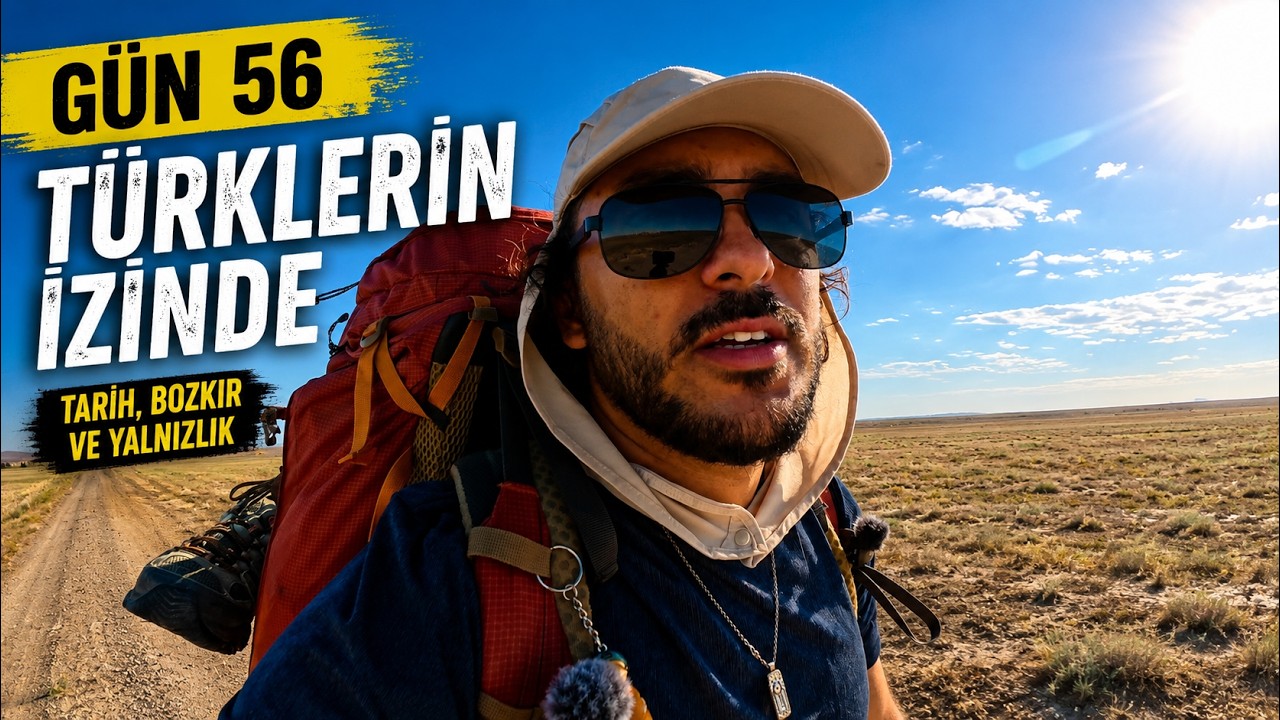
On days 56, 57, and 58 of my walk from Turkey to Mongolia, I traveled along the road from Aktau to Beyneu in Kazakhstan's Mangystau steppe. I said goodbye to my walking companion Bavırım at the Karaman Ata shrine, walked 34 kilometers, and arrived in Şetpe. The next day, with new shoes, I walked to the truck park in Nurbayan, communicating with Kazakh children on motorcycles in a mix of Turkish and Kazakh. On the third day, I was exhausted from salt loss in the shade-less steppe where temperatures exceeded 30 degrees. A truck driver's cold water and a Kazakh doctor's car, who had learned Turkish from TV series, saved the day. In this post, while describing those three days, I also share practical tips for anyone thinking of walking or traveling along the Aktau-Beyneu road: where to stay, how to manage water, how to take care of your feet, and which shoes work.
Watch the Video: Day 56, From Karaman Ata to Şetpe
Day 56: Saying Goodbye to Bavırım and 34 Kilometers to Şetpe
I started the day at the entrance of the Karaman Ata shrine. This is a highly visited place in the region, known for its underground mosque. I was told it was built in the 1200s and 1300s. Sources give different dates, so ask around if you go. My feet had been badly injured in previous days, so I rested for a few days. I bought a bandage that hardens the skin for blisters. My goal was Şetpe, 32 kilometers away.
I left my black dog Bavırım at the shrine. We had walked together for two days, but he was getting tired: he would lie down everywhere we stopped and get in front of me, trying to make me stop. At 35-40 kilometers a day, his paws would wear out, which would be hard on him. On the previous 42-kilometer day, when I shared my water and food with him, it wasn't enough for me. The reason I chose the shrine is this: Many visitors come, and people give food. Bavırım will now be the shrine's dog.
Along the way, I thought about the caravan days. From what I read, a horse can travel about 40 kilometers a day and drink 30-40 liters of water a day. A camel endures thirst much longer but travels around 30 kilometers a day. I was somewhere in between the two. In old caravans, the dog, camel, and horse were an inseparable trio. I understood better why that was in this steppe.
1. Shoe problem and flip-flops
At the 10th kilometer, my feet were in trouble again. I have flat feet, and the tip of the shoe was squeezing my toes. I put flip-flops over my socks and felt very relieved. This wasn't the first time I did this: Years ago in Nepal, I went to the Mardi Himal main camp in the snow with flip-flops. I tied the shoes to my bag and continued with flip-flops. It's not something I recommend, but sometimes this is the only solution with an injured foot.
2. When water runs low
Normally, I take 3 liters of water with me and drink 1 liter every 10 kilometers. In the afternoon, the temperature approached 35 degrees. There were more than 15 kilometers left, and my water had dropped to 1.3 liters. I rested in the shade of a closed building, and salt was pouring from my face. A little further ahead, a family picnicking next to a cemetery gave me about 750 ml of water and also offered chicken and bread. I also learned the Kazakh word "kalaysın" (how are you) from them.
Towards evening, herds of horses were running in the steppe. At the entrance of Şetpe, I saw Mangystau's famous round stones. There are many such naturally formed round rock formations in the region. I entered the town at sunset, and I took a photo with the children saying "Kazakhistan alga" (Forward Kazakhstan). I found a room at a cafe-hotel called Rahmet for 10 thousand tenge (about 20 dollars at the time). The ceiling had fallen down, the key didn't work, but there was a bed. I finished the day with 34 kilometers and 46,400 steps. Dinner was at Kuyurdak: a Kazakh dish made with meat, liver, and heart, with onions.
Watch the Video: Day 57, We Spoke Turkish with Kazakh Children
Day 57: From Şetpe to Nurbayan Truck Park
I rested in Şetpe for a few days, healed my feet, and bought new shoes. My only criterion when choosing was that they had mesh, and that was the only model in size 44. I put insoles in them. They let my feet breathe all day and were soft. I took 3 liters of water, a banana, an apple, and a sandwich with me. My goal was Nurbayan, 26-28 kilometers away.
It had rained at night, and the ground had turned into mud in places. At 1:20 PM, the temperature was 28 degrees and very humid. The sunscreen on my arm melted. A new problem also arose: The sharp corner of the bag and the HyperShell exoskeleton's waist strap squeezed my waist and caused a wound. I solved it by tying a piece of cloth in between. In long walks, these kinds of frictions seem small, but they turn into wounds in a few days. I collected the equipment I use in my travel equipment guide.
Along the way, the train line and natural gas pipe accompanied me. There is a railway from Aktau through Şetpe and Beyneu to Uzbekistan. From what I heard, there is no pedestrian crossing to Uzbekistan by land border, only trucks and trains can pass. This information is hearsay, check it from official sources before going. My plan is to walk to the border, and if I cannot cross, to continue by train or plane.
1. Break at an abandoned cafe
At the 12th kilometer, I sat in the shade of a wagon next to an abandoned cafe with a mess inside. According to the sign, I had come 169 kilometers from Aktau, and there were about 300 kilometers to Beyneu. While the local line on my phone showed "no service," the eSIM was working. You can also look at Kazakhstan eSIM packages from Yırtık eSIM; staying connected in this steppe is also important for safety.
2. History in the steppe
When I turned onto the dirt road, I thought about the history of these lands. The Huns, Scythians, Oghuz Turks, and Kipchaks passed through here, and then the Mongols came. Because of the nomadic and tent culture, very few traces remained behind. The wind and rain also cover the remaining traces with soil. My goal is to reach Ötüken, the ancient center of the Turks, via the Altai Mountains. I am not a historian, I am a storyteller. I recommend you also research what I explained in the video yourself.
3. Turkish with Kazakh children
Towards evening, two children on a motorcycle came to me. They said "Selamünaleyküm". Neither they knew Turkish nor I knew Kazakh, but we communicated with common words: rahmet (thank you), su (water), kuzu (lamb), mal (goods), çayhana (tea house), tamak (food), uyku (sleep), konak (stay). They said "yayav" to mean "walking". While saying goodbye, they said "yol olsun", meaning may your path be clear. They showed me the pond where animals drink water and told me there were two tea houses in Nurbayan, and I would arrive there in 2 hours.
In Azerbaijan, I understood most of the conversations, but in Kazakh, this is much harder. Still, the words were familiar. "Bala" means child in Kazakh, and "balaca" means small in Azerbaijani Turkish. The Kazakhs in the countryside were very warm-blooded.
I arrived in Nurbayan around 8 PM. In the first truck park, there were Turkmen, Kazakh, and Turkish trucks. There was a toilet, shower, prayer area, food, and repair shop, but there was no room. In the cafe-hotel next door, I found a clean, air-conditioned, three-bed room for 9 thousand tenge (about 18-20 dollars). There was no Wi-Fi. A meal full of meat was 12 dollars. I finished the day with 28.19 kilometers. It looked like 26-27 kilometers on the map, but the dirt road and zigzags extended the distance.
Watch the Video: Day 58, Kazakh Girl Saved My Life
Day 58: 100-Kilometer Void, Hot and Cold Water
In the 100 kilometers after Nurbayan, there is no village, town, nothing. Staying in a tent for two nights and carrying 15 liters of water was not for me. My plan was this: Divide the void into three 33-35 kilometer stages. Every evening return to the same place by bus or hitchhiking and stay, and the next morning continue from where I stayed. I paid 5 dollars for tea and water at breakfast. At 11:00, I set out with 4 kilos of water.
On the road, I saw herds of camels, horses, and cows. The horses escaping the heat had taken refuge in the vents under the road. When I saw a herd of about 50 camels, I went out onto the main road, because camels with young can become aggressive. I first saw a woman lying in the shade of a vent and got scared, thinking she was motionless, then she moved. She was probably the owner of the camels.
1. Natural air conditioning in the vent
Around 13:40, the only shade was a small vent. Although I was afraid of snakes, I went in. There were large black ants inside, but cool air was blowing from one end. I had walked 14 kilometers, about 20 kilometers remained. The temperature was 30, and the felt temperature was 35 degrees. It was the hottest day so far.
2. Trucker's cold water
A trucker who said hello and passed by turned his truck around and came back a little later. "What do you need?" he asked and gave me lemon-flavored, ice-cold water in 1.5-liter bottles. He also offered food and money. My water had decreased. I might not have died, but that cold water felt like medicine.
3. Salt loss
The second break was in a tunnel under the road. My feet were burning, and there were white salt traces on my skin and hat. I had never seen this much salt loss before. The previous day I had salty crackers with me, this time I didn't. I ate croissant, almonds, hazelnuts, and an apple, but salt was missing. If you are going to walk long in the heat, definitely take something salty or electrolytes with you.
4. Kazakh doctor and Aktau
Around 6 PM, while waiting for the Beyneu-Aktau bus that passes by, a car stopped. The driver was a Kazakh doctor living in Beyneu. He was going to Aktau for the weekend holiday. He had learned Turkish by watching "Muhteşem Yüzyıl" without speaking to anyone. His sister lived in Istanbul. "Come, let's go to Aktau, I am returning to Beyneu in two days, you return with me" he said. I was so tired that he seemed like an angel. We went to Aktau chatting along the way. My plan was to rest for two days and edit the video, then return to where I stayed and continue walking.
Practical Tips for the Aktau-Beyneu Road
| Topic | My experience |
|---|---|
| Accommodation | Cafe-hotel in Şetpe 10 thousand tenge (~20 dollars), next to Nurbayan truck park 9 thousand tenge (~18-20 dollars) |
| Food | A meal full of meat in Nurbayan 12 dollars, breakfast (tea and water) 5 dollars |
| Water | I drank about 3 liters in 30 kilometers; it was not enough for a hot day |
| Settlement | After Nurbayan, there is no settlement for about 100 km |
| Transportation | Beyneu-Aktau buses pass through this road; the train line goes to Uzbekistan from Şetpe and Beyneu |
| Weather (early June) | Daytime 25-35 degrees, humid days, it can rain at night |
| Internet | Local line did not work in the steppe, eSIM worked |
| Animals | Owned camel and horse herds, snakes, large lizards |
The prices are approximate figures from the period we filmed the video, they may have changed. I explained ways to stay cheap on the road in my cheap accommodation guide.
Frequently Asked Questions
How to go from Aktau to Beyneu?
I am walking, but Beyneu-Aktau buses pass through this road. There is also a train line going from Aktau through Şetpe and Beyneu. Check the current departure times from local sources.
Is there a place to stay in Şetpe?
Yes. I stayed in a cafe-hotel for 10 thousand tenge. There is also a hospital, market, and gas station in the town.
Where is Nurbayan, what is there?
A truck stop about 28 kilometers ahead of Şetpe towards Beyneu. In the truck park, there is a shower, food, toilet, and prayer area. You can find a room in the cafe-hotel next to it.
What to pay attention to when walking in the Mangystau steppe?
Water and salt are the most important. Salt loss is fast in the heat, take salty snacks with you. Stay away from camel herds with young, pay attention to snakes. Plan the uninhabited sections in advance.
Can you communicate with Kazakhs in Turkish?
Not completely, but there are many common words: su, rahmet, tamak, çayhana, kuzu. In simple conversations, you can communicate with gestures and common words. Russian is more common in cities.
In my previous post, I explained my arrival in Aktau and my first three days in the Mangystau steppe: Walking in Aktau and Mangystau desert. After resting in Aktau, I will return to the 100-kilometer void and continue walking towards Beyneu. I will explain the continuation of the journey in my next post.


0 comments